First, please breathe… no panic. Gluten-free preparing is easy. Trust us on that, because we have done it ourselves. Let us first go through the rules of sensible prepping, and then give you some thoroughly tasted options.
A quick but important note: the advice we give here is for gluten intolerance, not for gluten allergy. If you have a gluten allergy — or if you are Coeliac rather than simply gluten-avoiding — every product mentioned in this post should always receive a thorough check. Gluten-free labelling varies within a brand's range, and formulas change. Contact the manufacturer about cross-contamination on shared production lines.
Two Schools of Prepping Thought
As we discussed in our previous post on prepping, there are two schools of thought about what to put in your preparedness cupboard.
ONE
School number one says: store — for whatever period your government advises — what you already eat. Don't go fancy or expensive. Store what you know you can digest easily. In other words, fill your preparedness cupboard with the foods you eat daily or weekly.
That is a sensible rule. However, it comes with footnotes. Especially if you eat fresh vegetables and yoghurt every day. You can store these in your fridge, but in a blackout they will last three days at most.
TWO
Which brings us to school number two: store some freeze-dried meals that come back to life with a bit of hot water — heated on a camping stove or even a barbecue. These packets take up very little space and often carry a shelf life of a year or longer.
The catch? They are not automatically gluten-free. Or lactose-free, vegetarian, or vegan, for that matter. And this is where we — the Positive Preppers — have done some of the work for you: we bought the meals on the list below and tasted them ourselves.
Taste Before You Stock
Before you bulk-buy anything: test the meals yourself. Buy a few — whatever your prep budget allows — taste them, and notice how your body responds. Select the ones that suit you best, and suit the family or friends with whom you share a Preparedness Cupboard.
Then start collecting for three to eight days — or longer, should your government advise it.
The Happy Part of Preparedness
Here's the pleasant surprise: a preparedness cupboard is not a shrine. Every now and then, snatch a packet from the cupboard and use it. Replace it with the same item bearing a better expiry date. This is how you keep your SOS cupboard 'fresh' — and how you avoid discovering, in an actual emergency, that you can't stand the taste of what you stored.
Now I must confess: my family made a few mistakes here. We started treating a missed train, a late homecoming, a bout of flu — even simply having no idea for dinner — as 'calamities' and excuses to raid the SOS cupboard. The good thing: it's fun. The bad thing: it demands constant restocking.
Second confession: I always have eight bars of chocolate 'hidden' in our SOS cupboard. My family — like sniffer dogs — found them nonetheless. You will regularly hear me commanding: do not raid the SOS cupboard! Best to keep it in the attic or basement, safely out of reach.
Our Tasted List: Gluten-Free Freeze-Dried Camping Meals
From Norway: REAL Turmat (Drytech, Tromsø)
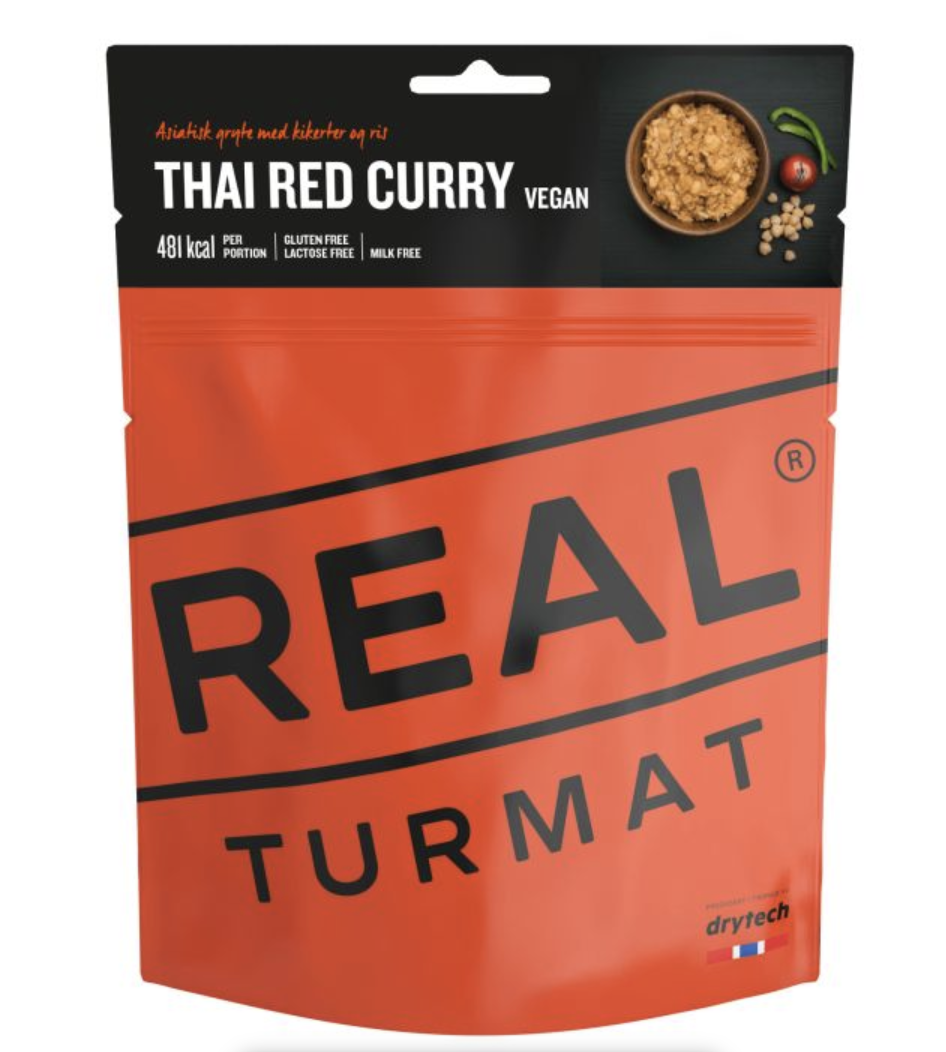
The benchmark. Vacuum-packed, with excellent taste and texture, and 13 gluten-free options in the range — for example Kebab Casserole/Stew, Beef Soup, Reindeer dishes, Pulled Pork with rice, Cod in Creamy Curry Sauce, and Crunchy Granola. The Field Meal range provides roughly 700 kcal, and Arctic Field Rations go up to about 1,500 kcal. Available at most camping and outdoor shops, or online.
Other strong gluten-free-friendly brands (EU/UK)
-
LYO Expedition (Poland/Czech Republic) — 100% natural ingredients, no preservatives; try the Traditional Polish Sauerkraut. Consistently rated among the best-tasting brands.
-
Firepot (UK, Dorset) — Dehydrated rather than freeze-dried, made with quality natural ingredients, and many gluten-free options; named among the four best-tasting brands by Outdoors Magic.
-
Summit to Eat (UK) — Good value with a generous gluten-free selection; the rice pudding with raspberry doubles as a lovely gluten-free breakfast.
-
Expedition Foods (UK) — The biggest selection for dietary requirements, including high-calorie options.
-
Extreme Adventure Food (UK) — Solid gluten-free options in multiple portion sizes.
-
Trek'n Eat (Germany) — Made in Hessen; several gluten-free meals, and good availability in Germany and the Netherlands.
-
Blå Band (Sweden) — Convenient, wide-opening packaging with several vegetarian and gluten-free options
- Wayfayrer (UK) — Ready-to-eat pouches with vegetarian, vegan and gluten-free options. For instance: Wayfayrer Vegetable Hot Pot Ready To Eat Meal.
Don't Forget the Treats
Alongside the meals, keep gluten-free chocolate and biscuits in your cupboard. Coffee, tea, and soy-, rice- or hemp-based protein powders for a nice brew. All of it helps to create a sense of normality — which will be so deeply appreciated when things are anything but normal for a few days or weeks.
If Your Budget Allows: NRG-5® ZERO Emergency Rations
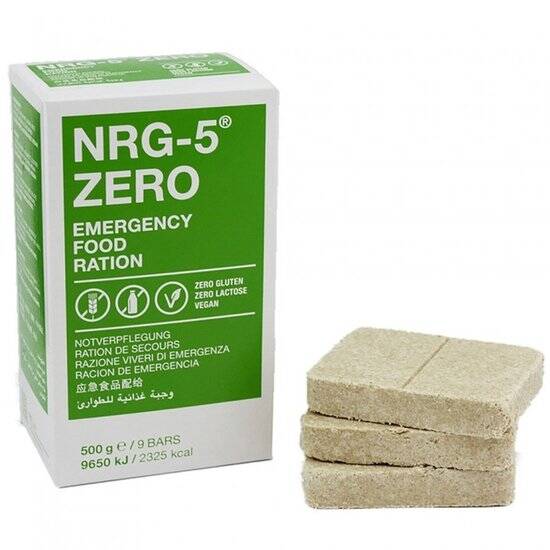
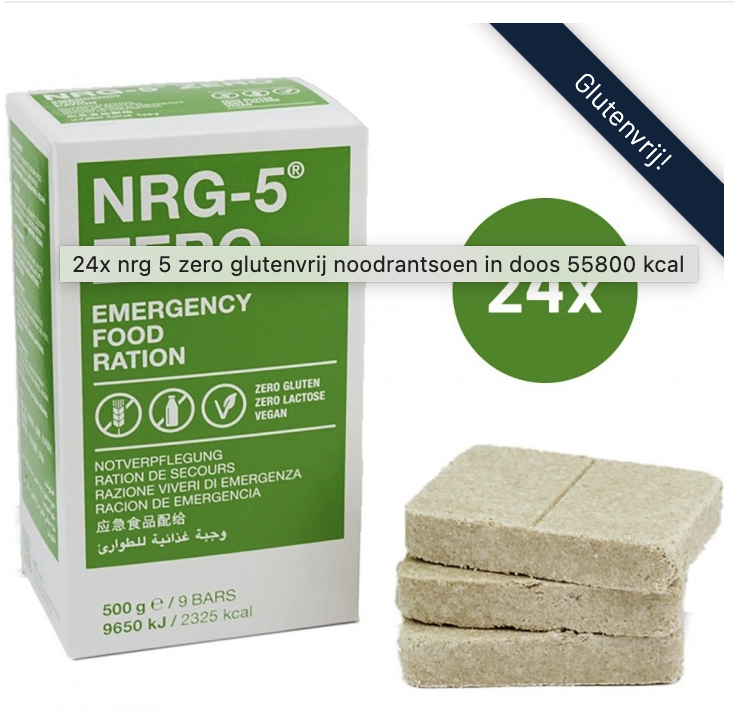
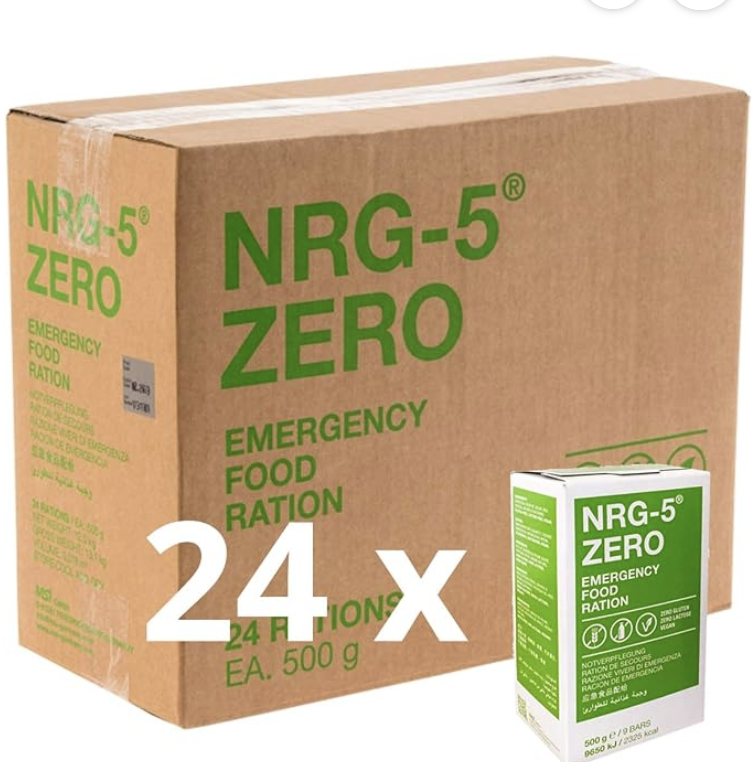
Should you have a little extra to spend, consider this gluten-free option: NRG-5® ZERO, a gluten-free, vegan, lactose-free compressed emergency ration made by Katadyn (the Swiss water-filter group, also the makers of Trek'n Eat). It's a 500 g vacuum-packed box of nine individually wrapped rice-based biscuit bars — made simply of baked rice, palm fat, sugar, rice protein and natural flavouring — delivering 2,325 kcal, a full adult day's energy, with an astonishing 15-year shelf life.
It needs no preparation or heating: eaten dry, crumbled into porridge (safe for children from six months), or mixed with more water as an energy drink, and it's compact enough for bug-out bags, go-bags or home food reserves. It's proven in real disaster relief — the standard NRG-5 and the ZERO version are regularly distributed by the UN and the Red Cross — and it's widely available across Europe. One practical note from users: it's drier and blander than the gluten-containing original, and eating too much of it can cause constipation — but as compact, long-life, gluten-free insurance, it's hard to beat.
Last, but Not Least: Enzymes
For many freeze-dried camping meals, it pays to have some gluten-digestive enzymes — and FODMAP enzymes — close at hand.
What's available in Europe?
-
GluteZym® (Biogena, Austria) — 200,000 PPI AN-PEP plus calcium and vitamin B2; ships EU/UK-wide.
-
GluteoStop® (Germany) — AN-PEP mini-tablets in a handy pocket click-dispenser.
-
GliadinX (made in Italy; sold via Amazon Europe) — high-concentration Tolerase® G; the enzyme itself is certified in Europe.
-
GlutnGo (Bricker Labs) and various 'gluten comfort' products — mostly US-sold but importable.
-
iHerb ships several AN-PEP formulas to the EU (do keep an eye on customs, though).
Do these enzymes actually work?
For intolerance and sensitivity — yes, but with limits:
-
A randomised crossover study (König et al., published in Scientific Reports) found that AN-PEP degraded gluten in a real meal setting: gluten levels in the stomach were around 85% lower than with placebo, in both high and low doses, working in both the stomach and the duodenum.
-
Importantly, the lead researcher stressed that the enzyme does not allow you to safely eat large amounts of gluten. It is meant for hidden or incidental gluten — cross-contamination, 'gluten-free' foods containing trace amounts, social situations — while you continue to follow a gluten-free diet.
For Coeliac Disease — no:
-
A separate study found no difference between AN-PEP and placebo in coeliac patients, and the Celiac Disease Foundation concluded that current enzyme supplements are ineffective as protection for coeliacs. Manufacturers state this explicitly: 'not intended to treat or prevent coeliac disease'.
In conclusion
If you have non-coeliac gluten sensitivity and want protection against small accidental exposures, AN-PEP products (GluteZym, GluteoStop, GliadinX) are the only ones with real clinical evidence behind them. Take them at the start of the meal, not after. They won't let you eat a full package that is not glutenfree — but they can blunt the hit from a stray crumb.
A note for those on a FODMAP diet: if your 'gluten intolerance' symptoms actually come from fructans in wheat — which is very common, as wheat fructans are a FODMAP — gluten enzymes won't help much, because they break down protein, not fructan carbohydrates. In that case the culprit isn't gluten at all, and spelt or sourdough tests, or a fructan challenge, will tell you far more. For this chapter, we refer Dutch readers to the Intoleran website.
Buy only food for your preparedness cabinet that clearly states it is GLUTENFREE. No experimenting. Especially not when calamities strike and health services have an extremely busy time. To need health services because of dietary experimentation should be avoided, not in the least because there are gluten free options.
~Your Positive Prep-Team~
Add comment
Comments