
When I decided to reupholster my vintage bench (you can read about that project in another blog), I quickly realised I didn't want to jump in completely unprepared. Although YouTube is full of helpful videos, I'm still someone who enjoys sitting down with a good book before starting a new craft. Books allow me to study techniques at my own pace, revisit pages, make notes, and understand why something is done instead of simply copying what I see on a screen.
Because I wasn't sure whether upholstery would become a long-term hobby, I didn't want to spend a fortune on books straight away. Instead, I downloaded several e-books and later treated myself to one beautiful printed edition. Looking back, the e-books alone already contained more than enough information to complete my first project successfully.
And that made me realise something rather interesting.
Most Upholstery Books Teach the Same Fundamentals
Whether you choose an inexpensive Kindle download or a beautifully illustrated hardcover, you'll quickly notice that most upholstery books cover exactly the same foundation.
They introduce the essential tools you'll need, explain different types of upholstery fabrics and fillings, teach you how to strip an old chair or bench, and guide you through rebuilding and recovering the piece step by step. You'll also learn how to examine furniture before you start, how to recognise quality construction, and why some pieces are much easier to restore than others.
These fundamentals hardly change from book to book because, quite simply, good upholstery has been practised in much the same way for generations.
But Here's the Reality...
No book can truly prepare you for your piece of furniture.
Every chair, stool, footstool, armchair, bench or sofa has its own surprises hidden underneath the fabric.
Some contain decades of repairs made by previous owners. Others have broken springs, damaged wood, missing tacks, crumbling horsehair or foam that has completely disintegrated. Sometimes you carefully remove one layer only to discover three more underneath.
This is why I found that the detailed step-by-step projects weren't always directly applicable to my own bench.
Instead, I constantly found myself combining knowledge from several books with common sense, patience, and quite a bit of trial and error.
And honestly?
That became part of the fun.
These Books Changed the Way I Look at Furniture
The greatest gift these books gave me wasn't technical knowledge.
It was inspiration.
After reading them, I could no longer walk through a charity shop, antique market or flea market without seeing possibilities everywhere.
Instead of looking at worn fabric, I started imagining rich linen, luxurious velvet or beautiful woven textiles.
Instead of seeing scratches and faded upholstery, I saw elegant curves, solid craftsmanship and furniture waiting for a second life.
It's a wonderful feeling when your eyes begin to recognise potential instead of imperfections.
That may sound a little dramatic—but if you've ever fallen in love with restoring furniture, you'll know exactly what I mean.
A Small Warning...
Be careful.
Upholstery can become wonderfully addictive.
The satisfaction of transforming an old, tired piece into something beautiful is incredibly rewarding. Every completed project gives you confidence to tackle something a little more ambitious.
Before you know it, you'll find yourself browsing online marketplaces "just to look," only to return home with another chair that "only needs a little work."
Ask me how I know...
My Recommended Upholstery Books
My personal favourites include the following titles, all of which are well regarded by both hobbyists and professional upholsterers. Many upholstery schools recommend building a small reference library rather than relying on a single book.
Which Books Would I Recommend?
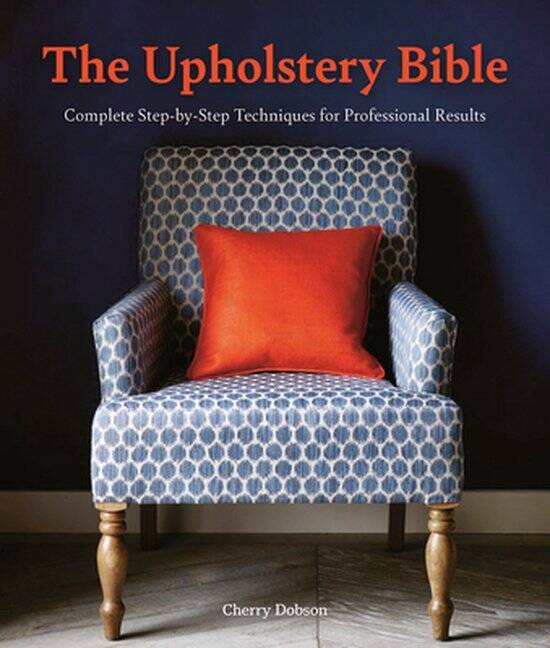
Of all the books I collected, my favourite is undoubtedly the most beautiful one.
Not necessarily because it contains dramatically different techniques, but because the photography, styling and finished furniture are simply stunning. It is one of those books that you happily leave on your coffee table because it inspires you every time you open it.
The other books are practical, informative and perfectly useful. They explain the craft clearly and cover all the essential techniques.
If I could offer just one piece of advice when choosing an upholstery book, it would be this:
Don't judge it by its cover.
If possible, flip through the pages before buying.
Pay attention to the photographs.
Look closely at the diagrams.
Can you clearly see what the author is demonstrating?
Do the illustrations make sense to you?
Those visual explanations are often far more valuable than beautifully written text.
Start Small, Then Build Your Library
If you're simply curious about upholstery, I wouldn't rush into buying expensive collector's editions.
Start with one or two affordable e-books.
They're inexpensive, practical and contain almost everything you need to complete your first project.
If, like me, you discover that you absolutely love bringing old furniture back to life, then it's worth investing in one or two beautifully produced hardcover books.
They become more than instruction manuals.
They become sources of inspiration that you'll return to again and again.
My Practical Advice Before You Begin
There is one thing that almost none of the books emphasise enough.
Make sure you have enough space.
Reupholstering furniture isn't a hobby that fits neatly onto a tiny corner of your dining table.
Once you strip a chair or bench, you'll suddenly have fabric, foam, batting, springs, webbing, tools, wooden parts and countless little tacks spread across the room.
Projects often take several days—or weeks—so your workspace needs to remain undisturbed.
You'll also discover something else rather quickly.
Old furniture is dusty.
Very dusty.
Sometimes surprisingly dusty.
So keep a vacuum cleaner nearby from the very beginning. You'll save yourself a great deal of cleaning later.
Enjoy!!
Learning upholstery isn't really about memorising instructions.
It's about training your eye.
It's about developing patience.
It's about appreciating traditional craftsmanship.
Most of all, it's about discovering the joy of giving a beautiful old piece of furniture a completely new life.
That old bench taught me far more than how to stretch fabric neatly over a seat.
It taught me to slow down, to enjoy the process, and to see beauty where others might only see something worn out.
And I have a feeling it won't be my last upholstery project.
Add comment
Comments