I read an essay on Iron Age mirrors. The Iron age started around 1200 BCE and ended roughly at 50 BCE. The essay was named 'Mirrors in the British Iron Age: Performance, Revelation and Power, by Melanie Giles and Jody Joy.' It inspired me immensely.
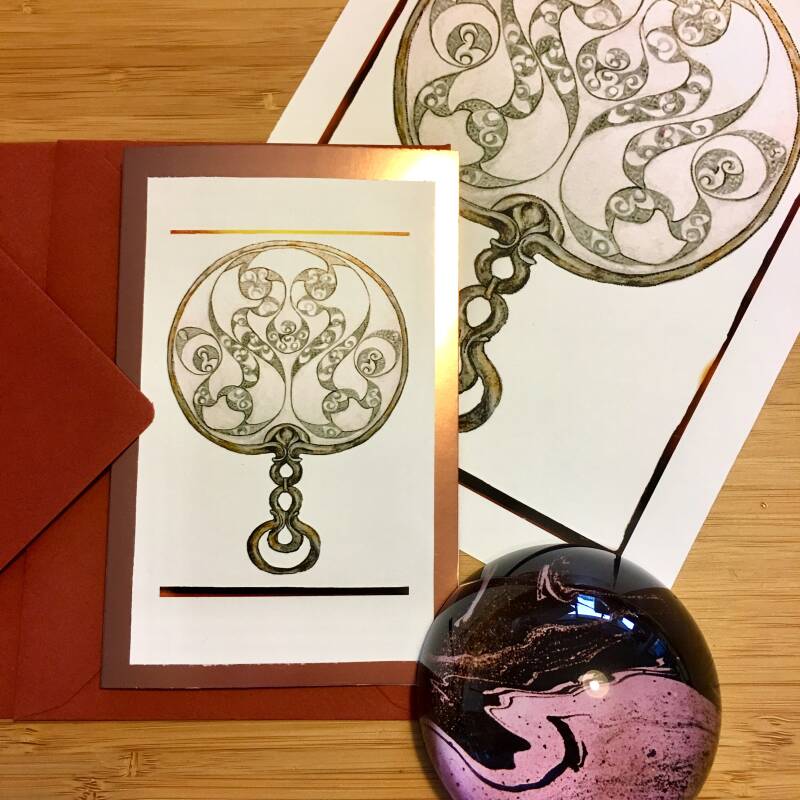
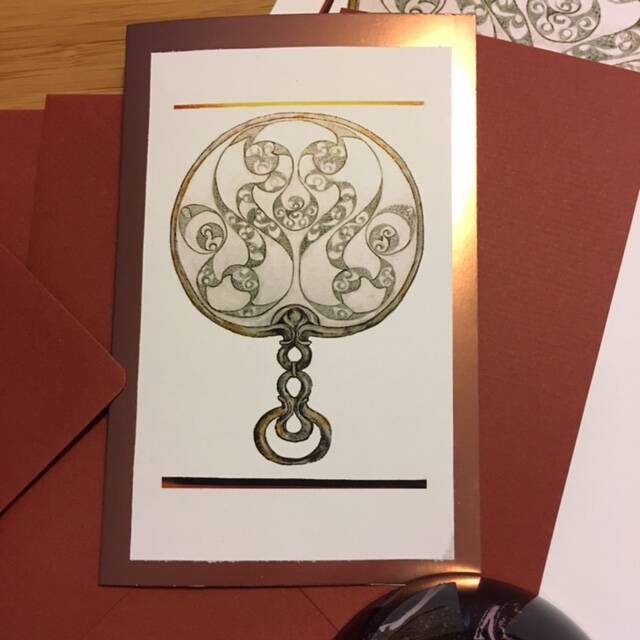
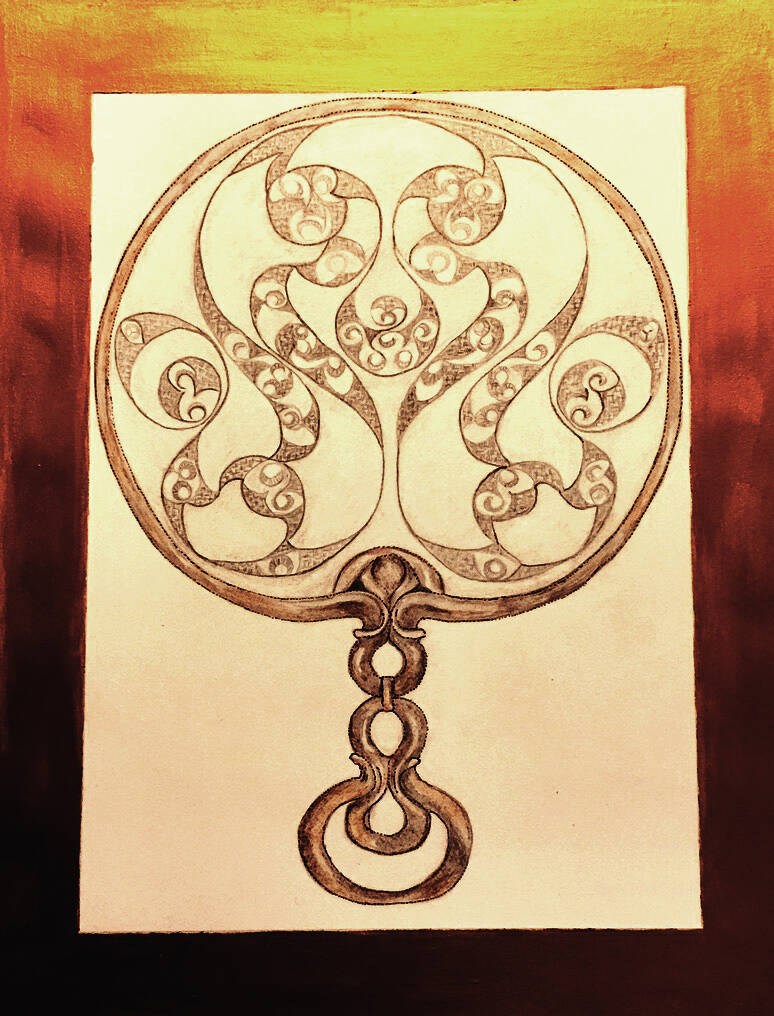
After reading about Iron Age mirrors, I set out to draw the Iron Age Desborough mirror.
Through drawing I would gain more insights into its decorations and its function.
Iron Age mirrors were beautifully decorated and made of bronze and iron. They were found in graves of high status Iron Age women.
I like to say something about high status Iron Age women. One might think 'high status' refers to rich women or wives of rulers or kings. But although both accounts can be correct, high status refers in the Iron Age more to women being leaders or shamans themselves.
The essay discusses how Iron Age metallurgy and how a whole community was involved in the making process. Also, it discusses social relations and grave goods. But my focus lay on reading about the motifs of repeated and distinctive forms arranged into intricate and flee flowing designs. Fascinating, to say in the least.
The question begs why were mirror used as grave goods? The easiest answer – possessions were buried with the owner -Iron age ladies- was perhaps incomplete. Perhaps the mirrors were not possessions but gifts. Gifts from the living to the dead. Because, why would a deceased lady take a mirror, it would be the least thing she would need in the afterlife, wouldn't it?
Imagine looking into this mirror. The effect of seeing your face in the reflective properties of the plate, disrupted or enhanced by its La Tene motifs (decorations) would ...yes, what would you see?
Giles and Joy describe how the decorations on the mirrors are not only used to deceive the eye, but also to reinforce the reflective qualities of the mirror plate. We have to imagine a time in which you only saw your reflection in (restless or calm) water, in shiny objects, like copper, bronze, silver or gold. How special -therefore- such mirrors would be!
Imagine now that next to not frequently seeing your reflection, you were raised to noticed all sort of shapes in water, in smoke, in old trees, and in rocks. We now have a clear sense of what we see is real and what is imagination, but for ancient people perhaps seeing was just seeing, whether it was imagination or fact. If the world of fact and fiction had not hard border, perhaps seeing imaginative, hallucinative and factual weren't compartmentalised.
MIGRAINE AURA
When I suffer a migraine aura, I see things that do not exist and things that I need to see are gone. I can be passed in the streets by somebody who is missing his head which feels very Harry Potterish. Perhaps looking into an Iron Age mirror yields a similar effect as having a migraine aura because Iron Age mirrors have blanked out spaces and thus provide viewers with a disorienting and distorted image of themselves. Yet, an Iron Age mirror has not only missing parts but also carefully chosen synchronised but flow-like playful, witty, and mischievous botanical and animal patterns. What effect would looking into a shiny plate, with a deliberate disorienting pattern have?
The essays explains more about the 'technology of enchantment' and goes deeper into psychological war-fare though powerful visceral and visual effects. It informs the reader about the Fang People of Gabon who used hallucinogens before looking into mirrors, and states that these Iron Age mirrors were not real mirrors (not for checking hair or make-up). In fact, the mirrors played a role in rituals to release the soul to its afterlife.
During the time that I spend drawing this Iron age mirror, I tried many things. I tried to project my face behind the decorations, fusing my face and the decorations and then see all sort of animals. Of course, this is a very poorly attempt to understand its magic. But I have to do with a large doses of imagination and hours of drawing as there is no way I would be able to hold the mirror up and have a look in it (they are archeological museum pieces). And even if I could hold an Iron Age mirror, there wouldn't be a ritual that would be helpfully preformed by an Iron Age shaman who would be experienced in travelling between worlds.
CONCLUDING THOUGHTS
My concluding thoughts are that by looking into this mirror, in an Iron Age ritual ceremony, with an Iron Age cognitive mindset, maybe, as a dying lady of high status, I would find great comfort in seeing my old face being obscured with these splendid swirling decorations. I would be calm as I have seen, thanks for my migraines, often enough things that aren't there and fail to notice things that are there. I would probably enter theta brainwaves the same way as after sitting down for a longer time in meditation or -more Iron Age style- looking into the smokey swirls of an open camp fire. I might start seeing my face, combined with the swirly flowing embellishments turning into animals and ancestral spirits.
One has to understand that the Iron Age was full of spirits, spirits we have abandoned from our modern life. But just as they have been forgotten, it doesn't mean these spirits aren't there. I would most certainly find an ancestral spirit that would 'present' itself as so much of my own face would be blanked out, and only some essential and familiar facial lines would still linger in the reflective image.
Or perhaps, I would see a beautiful stag or other horned mammal, and experience it as my guiding spirit animal. Perhaps I would see the hybrid human-animal dressed-up shaman of the village giving me instructions to journey to the Otherworld. I -as an Iron Age lady- would find great comfort in feeling surrounded by ancestral or animal spirits.
All in all, it would perhaps release my soul into an in-between world in which I would be able to project comfortably to what I would need to see (wishful seeing). I would probably have been fasting during the last days of my life, I would be susceptible for my imaginative mind to dominate and thus the softly and dreamily reflecting mirror would get a transitional quality and function. Or perhaps I would look and utter some wise words, like Tibetan shamans who look into mirror to see the future and the past, wise words that would be helpful to my tribe. The Fang people of Gabon using mirrors to contact their ancestor. Or Sauron, using his palantír -his crystal ball-, although he isn’t a kind man but a Dark Lord according to his creator J.R.R. Tolkien. Why wouldn't Iron Age mirrors have a similar function?
Obviously, many things become possible should such a highly valued mirror be available to a tribe. There are many more Iron Age mirror than the Desborough mirror alone.
One by one these mirrors and their fascinating embellishments are showing us that Iron Age metallurgy and shamanism practices were interrelated and that wonderfully decorated 'magic' Iron Age mirrors were highly valued by Iron Age peoples.
Paula Kuitenbrouwer

Iron Age mirror,
found in 1908 near Desborough, England.
Hand drawn without digital assistance by Paula Kuitenbrouwer and placed on bronze metallic paper.

Nice Musings
Are we as happy with our modern mirrors as Iron Age peoples were with theirs? Is looking into a mirror still filled with imagination? Is our self-reflection objective or subjective?
Perhaps, we are still rather prehistoric with mirrors. We look into mirrors to muse about ourselves, to obscure our wrinkles with a bit of make-up, to camouflage our spots, and highlight our eyes. There is still a lot of imaginative interaction between a mirror and ourselves.


Reactie plaatsen
Reacties