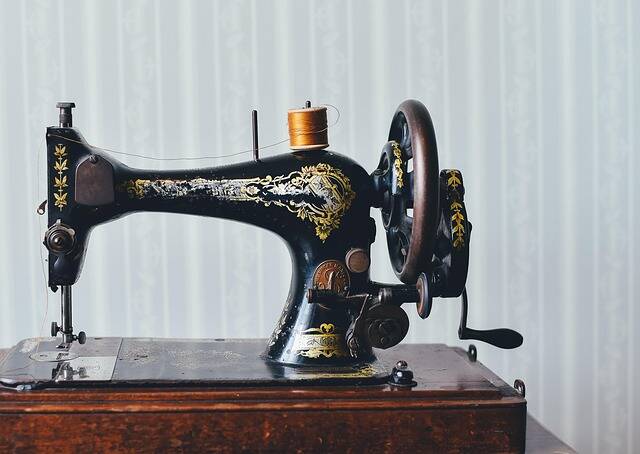
Sewing Without Electricity
The autumn days are coming.
The light disappears a little earlier each evening, the temperatures become cooler, and we naturally spend more time inside our homes.
For me, this is a wonderful time for making things.
There is something very satisfying about sitting at the sewing table on a long autumn evening and making something useful for your home. A cushion cover, a table runner, kitchen towels, fabric bags or perhaps something as simple as repairing a favourite textile.
And there is another interesting possibility.
You can do it without electricity.
Not with a modern electric sewing machine, but with an old-fashioned treadle or hand-operated sewing machine.
This is where sewing becomes more than just a hobby.
It becomes a small lesson in self-reliance.
Self-reliance starts with skills
When we hear the word preparedness, we often think about storing food, water, candles or batteries.
Those things can certainly be useful.
But I believe preparedness is also about something much simpler:
having practical skills.
Knowing how to repair something instead of immediately replacing it.
Knowing how to make something yourself.
Knowing how to use a simple tool without depending completely on electricity, computers or modern technology.
Sewing is one of those skills.
And you do not need an expensive sewing room to begin.
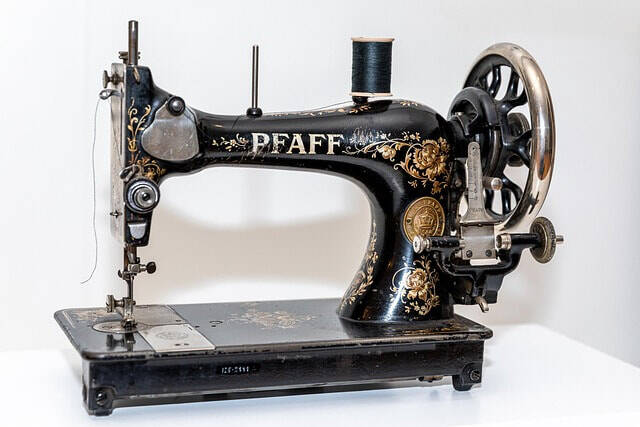
The wonderful old sewing machine
I have two vintage sewing machines myself.
They are the heavy, cast-iron beauties that you sometimes still find in Dutch thrift shops, or kringloopwinkels.
Sometimes you can find one for around €25 - 100.
Of course, prices vary, and some beautiful or rare machines cost considerably more. But old sewing machines are often surprisingly affordable.
They are also surprisingly heavy!
That heavy cast-iron construction was made to last. Many of these machines have already been working for generations.
And the most interesting thing?
Some of them do not need electricity at all.
A treadle machine is operated with your feet. Other old machines can be operated by hand.
No plug.
No electric motor.
No screen.
Just a mechanical machine, your hands and your feet.
My own vintage machines
I have two of these old machines in my atelier.
They still work very well.
Of course, using one is completely different from using my modern Bernina. My Bernina is fast, precise and wonderfully convenient. I can choose stitches with a touchscreen and use all kinds of modern features.
The old machines ask something different from me.
I have to find their rhythm.
I have to control the speed.
I have to listen to the machine.
And I have to remember that I am working with a piece of mechanical equipment rather than a modern computerised machine.
It is slower.
But that is not necessarily a disadvantage.
Sometimes slowing down is exactly what we need.
A useful skill for the home
One of the things I particularly like about sewing is that it can be both creative and practical.
You can make things that are genuinely useful around the house.
For example:
-
cushion covers
-
kitchen towels
-
table runners
-
fabric napkins
-
bread bags
-
storage bags
-
simple curtains
-
pot holders
-
fabric baskets
-
reusable shopping bags
-
repairs and alterations
You do not have to make something complicated.
A simple piece of linen can become a beautiful kitchen towel.
A leftover piece of sturdy cotton can become a useful storage bag.
An old textile can sometimes be repaired or transformed instead of thrown away.
This is self-reliance in a very ordinary and practical form.
Making your home beautiful without electricity
There is another part of this that I particularly like.
Self-reliance does not have to mean giving up comfort or beauty.
Quite the opposite.
You can make your home more beautiful with your own hands.
Imagine a long autumn evening.
The house is quiet. You have a cup of tea beside you. Your vintage sewing machine is on the table.
Perhaps you are making new linen cushion covers for the living room.
Or a set of simple fabric napkins for the kitchen.
Or perhaps you are repairing a favourite tablecloth.
You are not simply passing the evening.
You are making something.
And you are learning a skill that stays with you.
That, to me, is a very pleasant form of self-reliance.
What happens when the power is off?
There is also something reassuring about knowing that your sewing does not have to stop when the electricity does.
Of course, I am not suggesting that a vintage sewing machine will solve every problem during a power outage.
But it is one small example of how traditional tools can still have a place in a modern household.
If the lights are off, an electric sewing machine cannot help you.
A treadle machine can.
You can still repair a torn textile.
You can still make a simple household item.
You can still work with your hands.
And perhaps most importantly, you have not lost the skill simply because a modern convenience is temporarily unavailable.
The autumn project
This autumn, you could make a small self-reliance project for your home.
You do not need to start with a complicated dress or a large quilt.
Start with something simple.
Perhaps make four linen napkins.
Or two cushion covers.
Make a bread bag.
Repair some kitchen textiles.
Turn an old piece of fabric into useful storage bags.
The project itself is not the most important part.
The important part is learning.
Learn how to cut fabric.
Learn how to make a strong seam.
Learn how to repair a mistake.
Learn how your sewing machine works.
And, if you find an old treadle machine, learn how to clean and maintain it.
There are books and other resources available that explain how these old machines work. Learning to bring an old machine back into good working order can become a hobby in itself.
Self-reliance does not mean doing everything yourself
I also think it is important to say that self-reliance does not mean that we must do everything ourselves.
Modern technology is wonderful.
I use it every day.
I certainly appreciate my modern sewing machines, and I would not want to give them up.
Self-reliance simply means having another option.
If you know how to sew, you can repair something.
If you know how to preserve food, you have another way of storing food.
If you know how to mend, you do not have to replace every damaged item.
If you understand how a simple tool works, you are less dependent on complicated systems.
Small skills add up.
A different kind of luxury
At Handmade Luxury Home, we often think about handmade things as beautiful objects.
But handmade can also mean something more.
It can mean independence.
It can mean knowing where something came from and how it was made.
It can mean being able to repair rather than replace.
And it can mean having the confidence to say:
“I can make this myself.”
That is a very different kind of luxury.
Not the luxury of owning more.
The luxury of knowing more.
One stitch at a time
Perhaps that is why I find these old sewing machines so fascinating.
They remind us that many things we consider complicated today were once ordinary household skills.
People made, repaired and reused.
They worked with what they had.
And they did not need a screen to tell them what to do.
So when the autumn evenings become longer, perhaps look at sewing in a slightly different way.
Find an old sewing machine.
Learn how it works.
Make something useful for your home.
Repair something instead of throwing it away.
And enjoy the quiet rhythm of making something with your own hands.
Self-reliance does not have to begin with a big plan. Sometimes it begins with a needle, a piece of fabric and one simple stitch.
Add comment
Comments