
On the Importance of Chocolate in your Preparedness Cupboard
(and if it isn't important, we make it important :-)
Let us first look at how important bars of chocolate were for World War II soldiers. These simple bars of chocolate were any soldier's Pocket Ally.
In the hardships of World War II, a small bar of chocolate proved to be one of the most trusted companions a soldier could carry. Compact yet dense with energy, chocolate delivered fats, proteins, and sugars in a form that took up almost no space in a kit bag and would not spoil in heat, cold, or long months of transport — a rare virtue in an era when much food quickly turned.
The United States even commissioned a special high-energy "D-Ration" bar designed to withstand the tropics and sustain a man in an emergency, while Allied soldiers and airmen treasured chocolate not only as fuel, but as morale: a small taste of home, sweetness amid hardship, and — in the hands of liberating troops — something to share with hungry, grateful children. We all have seen these movie scene when WWII soldiers give a bar to a child in distress. It touches us. In a war measured in endurance as much as in battles, chocolate quietly did its part.
The Hershey's D-Ration bar (1937) was famously almost too durable — designed to taste "a little better than a boiled potato" so soldiers wouldn't snack on it casually, and so hard some men shaved slices off rather than biting it.
British troops received chocolate in their Composite Rations, and it was standard in aircraft escape kits — pilots downed behind enemy lines depended on it.
The famous story of chocolate crossing the front lines: American soldiers handing out Hershey bars to liberated Dutch, Belgian and French children is one of the warmest small memories of the war — fitting, given your interest in the Low Countries' wartime history.
(continue under the photo)
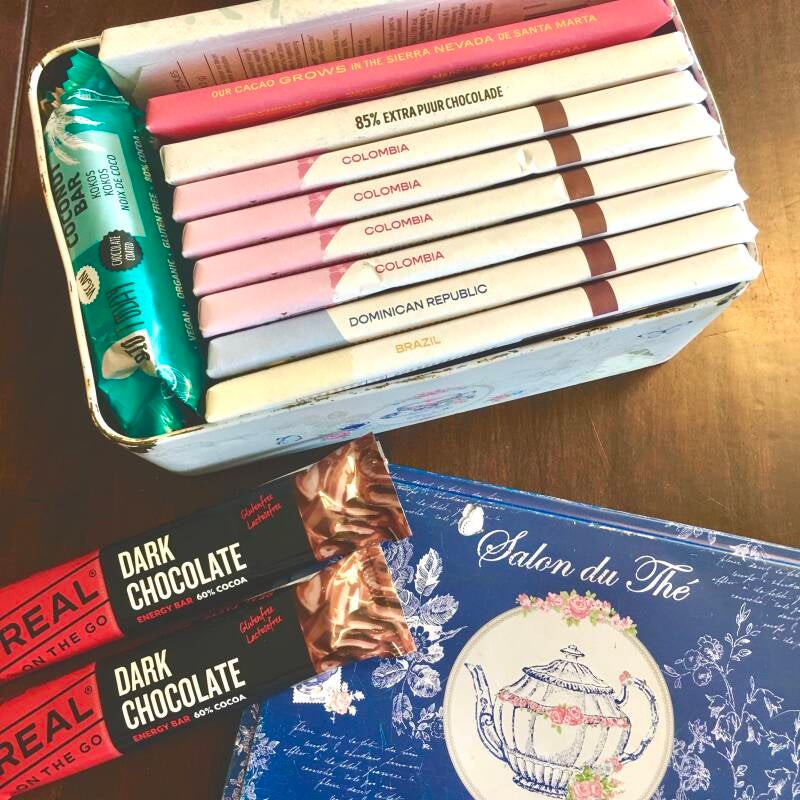
The same virtues that carried chocolate through wartime still make it one of the wisest items in a modern preparedness cupboard.
And that is very good news!
A good dark bar is remarkable emergency food: dense in fats and sugars for quick energy, with enough protein and micro-nutrients to matter when meals become simple, and — kept cool, dry, and unopened — it stays edible for a year or more, often well beyond its printed date. It asks nothing: no cooking, no water, no preparation, and it takes up barely more room than a bar of soap.
But its greatest gift is the one no ration table can measure: comfort. Some even say: love. Like chocolate is love and love is chocolate. and there are always those who push this even further: chocolate is life and life is chocolate.
In a power cut, a stormy night, or any day when the world feels uncertain, breaking off a square of chocolate restores a sense of ordinary life faster than almost anything else in the cupboard. Have coffee and tea stored. Together with a bit of chocolate, it will give a sense of normalicy and relaxation.
Choose plain dark chocolate of 70% or more — it keeps best and has the least to spoil — store it in a sealed tin away from light and heat, and rotate your stock by enjoying a square now and then. Preparedness, after all, should taste pleasant.
A few practical notes:
Storage: a sealed metal tin (biscuit tin works beautifully) works best, protecting the chocolate against light, moisture, and — importantly — pests, which can be drawn to stored food.
How much: for a household emergency reserve, a few 100 g bars per person is plenty; this is a comfort-and-energy item, not a staple.
No Nuts, Rice etc.: choose plain chocolate, without nuts or other stuff. Chocolate with hazelnuts, rice, almonds may be the lovelier treat on an ordinary bar, but nuts contain oils that turn rancid far sooner than chocolate itself — a bar that would have kept for two years can taste of pencil shavings within months.
Rotation: -Here the good news!- chocolate past its "best before" is usually still safe (the white film that sometimes appears is just cocoa butter rising to the surface — harmless), but flavour fades, so eat and replace.
(continue under the photos)

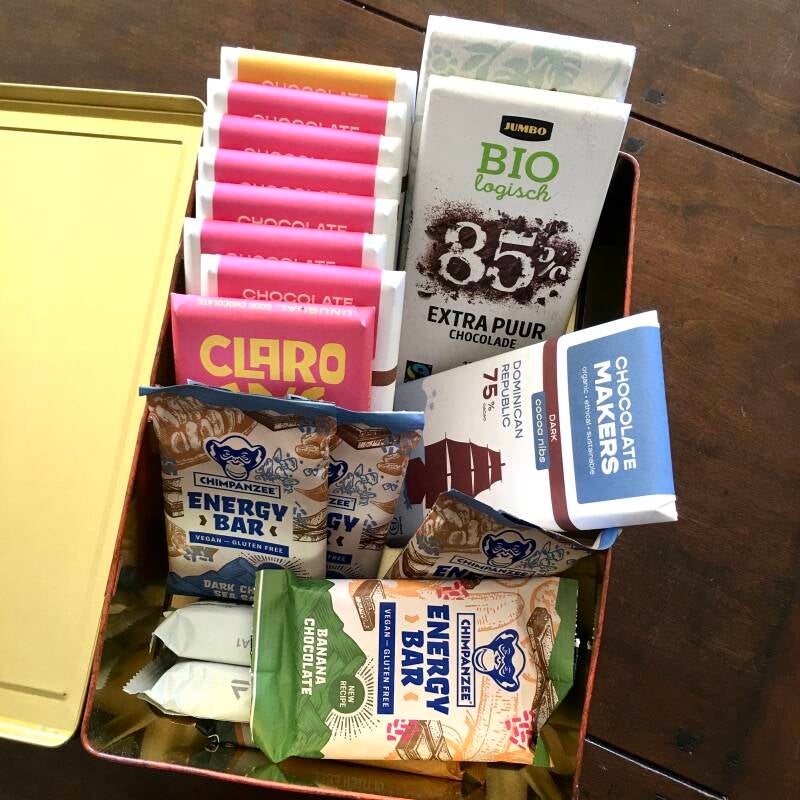
There are many more brands, but these are among the gluten free- milk free ones. Just check labels!
Also think of chocolate flakes and sprinkles, though they have shorter shelf life, which means keep rotating.

Real (Real Turmat) Chocolate has a great expiry date and is gluten free & lactose free, but it is only 60% chocolate and higher in sugar.
Find the bars that go well with your needs.
Chocolate & Diabetes
Not only do we address gluten-and milk free chocolate. We like to inform those with diabetes too.
The best diabetes-friendly chocolate without any sweeteners (no maltitol, erythritol, stevia, nothing) is simply very high-percentage dark chocolate, where the only "ingredients doing the work" are cocoa and a small amount of sugar.
The principle: the higher the cocoa percentage, the less sugar. Thus some examples of bars that are widely available in Europe:
- Lindt Excellence 85% — the classic, affordable, everywhere; often cited as the go-to diabetic-friendly bar.
- Lindt Excellence 90% and 99% — for when even 85% feels too sweet; the 99% bar contains about 1 g sugar per 100 g, essentially a "no-sweetener, no-sugar" chocolate that still tastes of real chocolate.
- Green & Black's Organic 85% — organic, clean list.
- Any single-origin / bean-to-bar 90%+ bar from a good chocolate shop — often just two or three ingredients.
HOWEVER:
Portion is still king. Even a 99% bar is calorie-dense; the diabetes-wise serving is one or two squares (10–20 g) as a deliberate moment — not the whole bar. And pure 99% is intense: many people find a small portion genuinely satisfies, which is itself an advantage.
Do not eat 99% too much or after lunch. Many of us need time to wear off the theobromine (acting like caffeine).
Here is the maths:
A 99% bar contains a substantial dose: dark chocolate has about 200 mg theobromine per 28 g (Wikipedia), and a 99% bar even more — so a modest 15 g portion delivers roughly 100–150 mg. Doing the maths with a ~7-hour half-life:
- After ~7 hours: half is still in your system
- After ~14 hours: a quarter remains
- After ~28–35 hours (4–5 half-lives): effectively cleared — so fully worn off takes about a day to a day and a half
Beware of "diabetic chocolate" labels. Most of those products replace sugar with sugar alcohols (maltitol etc.), which can still raise blood glucose in some people and cause digestive complaints — sweeteners you want to avoid. A plain 85–90% bar is usually the cleaner and tastier choice.
The best chocolate for diabetes isn't a special product at all — it's simply more chocolate and less everything else.
Add comment
Comments