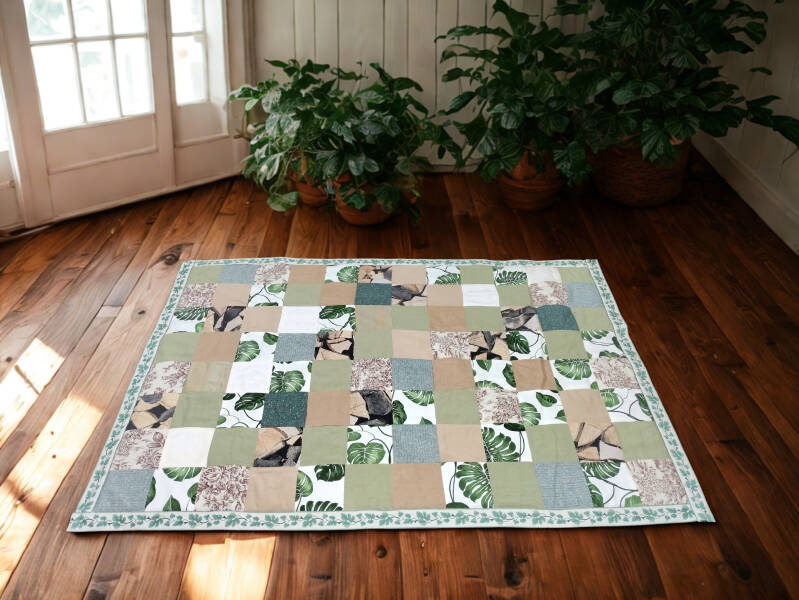
What makes a handmade textile object special? Is it the design, the materials, the colours, or the person who made it?
For me, quality is something you can often see when you take a closer look. But there is also something you cannot always see immediately: the time, patience and love that went into making it.
As someone who sews, makes quilts and creates textile wall art, I have developed a habit. I look at almost every textile object with a critical eye. And I mean almost everything!
Even when I look at clothes in a shop, I find myself examining the seams, the zips, the fabric and the finishing. These days, I rarely buy clothes for myself, but when I look at clothes for my children, I cannot help noticing the details.
The same happens when I look at cushions, quilts, curtains, bags or other textile products for the home.
I simply look closer.
Look beyond the first impression
A beautiful design is important, of course. But the first impression does not always tell you much about the quality.
Look at the seams. Are they straight and neat? Are the edges properly finished? Do the seams look strong enough for everyday use?
If there is a zip, look at how it has been placed. Does it open and close smoothly? Is it a good-quality zip? Has it been sewn in neatly, without pulling or puckering the fabric?
Then look at the fabric itself.
What kind of material is it? Does it suit the purpose of the object? How does it feel? Is it strong enough? Does it have the right weight and structure?
And what about the washing instructions? A beautiful textile object should also be suitable for the way it will be used and cared for.
Finally, look at the complete object. Do all the details work together?
Quality is not just one good seam or an expensive fabric. It is the combination of many small decisions.
Mass production and the pressure of time
Something I often notice in inexpensive textile products is how quickly they appear to have been made.
Of course, mass production is not always poor quality. There are well-made products in shops, too. But when production is focused mainly on keeping costs low and making large quantities quickly, there is often less room for individual attention.
Sometimes the stitching is rushed. Sometimes the finishing is rather careless. A small detail that could have been improved has simply been left as it is.
And that is where I start to see the difference between a product made quickly and an object made with craftsmanship.
The difference is not always in the design or the materials. It is often in the attention given to the final details.
The last 20% can make all the difference
I sometimes think of making something as an 80/20 process.
The first 80% is making the object: cutting the fabric, joining the pieces, building the shape and creating the design.
But the last 20% is the finishing. And this part can take a surprisingly long time.
It may involve checking every seam, correcting small imperfections, finishing edges, adding details and making sure that everything looks and feels right.
In my experience, this final stage often takes more time than people expect.
It is tempting to say that an object is finished when it is already taking shape. But for me, it is not finished until I am happy with the details.
This is where craftsmanship becomes visible.
Time, patience and love for the craft
When I look at textile art, I often think about the books and stories that show the work behind traditional crafts.
For example, The Seamstress of Sardinia is a lovely starting point for thinking about sewing, tradition and the lives of women who worked with textiles.
Books about leatherworking, historical clothing and traditional embroidery also remind us how much knowledge and patience are involved in making things by hand. And then, of course, there is my own work.
I do not usually keep a strict record of the hours I spend making a quilt or a textile wall hanging. I have never really worked that way.
Sometimes I can spend weeks or even months on one piece. I might put it aside for a while and return to it later. An idea can develop slowly, change direction and become something quite different from what I first imagined.
There are no strict deadlines and no demanding customer requirements when I make these pieces for myself or for our home.
The process itself is part of the pleasure.
Something develops through the hands, the sewing machine and the imagination of the person making it. It is not always planned from beginning to end. Sometimes the work tells you what it needs next.
A little squirrel, a lot of time and two pairs of hands
A lovely example is our textile wall hanging with a squirrel.
The idea slowly developed between Paula and me. We worked together, passing the project from one to the other. Sometimes I worked on it, sometimes Paula did. We sent it back and forth, each adding something or continuing where the other had stopped.
There was no hurry.
In fact, after a while, we had almost forgotten about it! It took about half a year before the wall hanging was finally finished.
And now it hangs in one of our homes.
Sometimes someone looks at it and asks:
"How lovely! Where did you buy that?"
Or:
"Who made it?"
And the answer is simply:
"I did. We did."
Not because we wanted to produce something for sale. Not because there was a deadline or a customer waiting.
We made it because we enjoyed making it. Because we love textiles, sewing and working with our hands.
And that makes it special to us.
Handmade quality is more than perfect stitching
Of course, good craftsmanship needs knowledge and skill. Neat stitching, suitable materials, strong construction and careful finishing all matter.
But handmade textile art is also about the decisions made along the way.
Why this fabric? Why this colour? Why this shape? Should a detail be changed? Does the object need another afternoon of work, or is it finally right?
These small decisions are part of the creative process.
A handmade object does not have to look like it came out of a factory. In fact, a little individuality is often part of its charm. What matters is that the work has been made with care and that the maker stands behind the result.
Take a closer look
The next time you look at a handmade quilt, a textile wall hanging, a cushion or a piece of clothing, take a moment to look beyond its appearance.
Look at the seams. Feel the fabric. Notice the finishing. Look at how all the details come together.
And perhaps ask yourself how much time and attention went into making it.
Because quality is not always loud or obvious.
Sometimes it is hidden in a tiny, carefully finished corner, a beautifully placed zip or a detail that nobody notices at first.
For me, that is the beauty of handmade textile art.
Time is part of the quality. And love for the craft is part of the result.
Marga van der Vet
Add comment
Comments