
Smocking as Textile Art: From Old-Fashioned Needlework to Modern Interiors
For a long time, I had a rather old-fashioned idea about smocking.
When I thought about smocking, I imagined small children's dresses, very neat little stitches, and books from another time showing rather fussy clothing.
I have some of those books in my sewing library.
Yes, the examples can look wonderfully old-fashioned today!
But here is the funny thing: the books may look dated, but the technique inside them is absolutely beautiful.
The more I work with smocking, the more I see how much potential it has outside clothing.
Smocking can be much more than a detail on a blouse or dress.
It can become textile art.
What is smocking?
Smocking is a traditional needlework technique in which fabric is gathered and then secured with decorative stitches.
The stitches create patterns and shapes while keeping the gathered fabric flexible.
There are many different smocking techniques and patterns. Some create diamonds and honeycomb shapes, while others form waves, flowers or geometric designs.
The beauty is that the decoration is not simply added to the fabric.
The stitching actually changes the fabric itself.
It creates texture, depth and movement.
That makes smocking particularly interesting for interior textiles.
Don't be fooled by the old books
I recently looked again at some of my older sewing and needlework books.
The photographs and illustrations are, frankly, wonderful examples of what we might call very traditional taste.
Some of the projects look extremely formal. Others have that unmistakable 1950s or 1960s feeling.
You might look at them and think:
This belongs in my grandmother's sewing room.
Perhaps it does.
However, don't make the mistake of dismissing the technique because of the style in which it was presented.
The actual needlework is often exquisite.
The precision, the rhythm of the stitches and the way the fabric is manipulated are fascinating.
This is one of the things I love about traditional needlework.
Styles change.
Colours change.
Interiors change.
Nonetheless, a good technique remains a good technique.
Sometimes an old technique becomes something completely different when we place it in a modern setting.
Smocking as art for the home
This is where I think smocking becomes really exciting.
Instead of using it on a blouse or a child's dress, imagine smocking on a large piece of linen hanging on a wall.
Or on the centre panel of a decorative cushion.
Or incorporated into a textile artwork.
The gathered fabric creates shadows and highlights. When the light changes during the day, the surface changes with it.
It becomes almost three-dimensional.
This is why I think smocking belongs in the world of needle art and textile art.
It does not have to be a small decorative detail.
It can be the main event.
Wall hangings
One of the most beautiful applications is a textile wall hanging.
We are very used to seeing paintings and prints on our walls, but textile art brings something different into an interior.
It is soft.
It has texture.
It absorbs light rather than simply reflecting it.
And it can add warmth to a room without making it feel cluttered.
Smocking can be used as a central feature in a wall hanging, combined with embroidery, quilting, appliqué or other forms of needlework.
A large piece of natural linen with carefully worked smocking can be incredibly striking.
Especially when the design is allowed to remain simple.
Sometimes you do not need a complicated picture.
The texture itself becomes the artwork.
Cushions with a difference
Cushions are another wonderful place to use smocking.
A cushion with a smocked front can look completely different from a standard embroidered cushion.
The fabric itself becomes dimensional.
It catches the light differently and feels different under your hands.
Imagine a natural linen cushion with a subtle geometric smocking pattern.
Or a deeper, more sculptural design in cotton.
Or smocking combined with embroidery around the edges.
There are so many possibilities.
And this is where handmade textiles have such an advantage over mass-produced home decoration.
You can choose the fabric, the pattern, the scale, the colour and the amount of decoration.
The result can be made specifically for one room.
Smocking and other needle art
Smocking does not have to work alone.
I particularly like the idea of combining traditional techniques.
For example, a textile artwork could include:
-
smocking
-
hand embroidery
-
appliqué
-
quilting
-
patchwork
-
decorative stitching
-
fabric manipulation
-
lace
-
carefully placed woven details
These techniques can be combined in a very contemporary way.
The result does not have to look historical at all.
It can be minimalist, rustic, romantic, elegant or even quite modern.
The traditional technique is simply the starting point.
A beautiful connection with natural fabrics
Smocking also works beautifully with the kind of fabrics we love at Handmade Luxury Home.
Linen and cotton are wonderful materials for needle art.
They have a natural texture and age beautifully.
When you add hand stitching, the fabric becomes even more personal.
There is something very satisfying about working with a natural material and changing its surface with nothing more than thread, needle and patience.
It is slow decoration.
And perhaps that is exactly what many interiors need today.
We live surrounded by things that are made quickly.
Textile art reminds us that some things are worth making slowly.
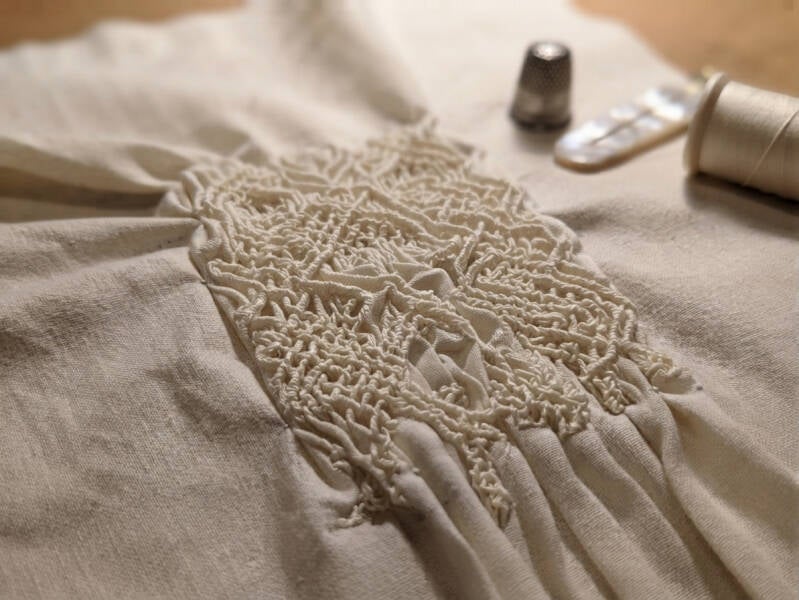
(AI example Advanced Smocking Art)
From sewing technique to textile sculpture
The more I work with smocking, the more I think of it as a form of textile sculpture.
A flat piece of fabric can be transformed into something with volume.
The folds create shadows.
The stitches create lines.
The pattern creates rhythm.
And the whole piece changes when you touch it or when the light falls across it.
That is very different from simply printing a pattern onto fabric.
The decoration is built into the textile itself.
For me, that is where the real magic happens.
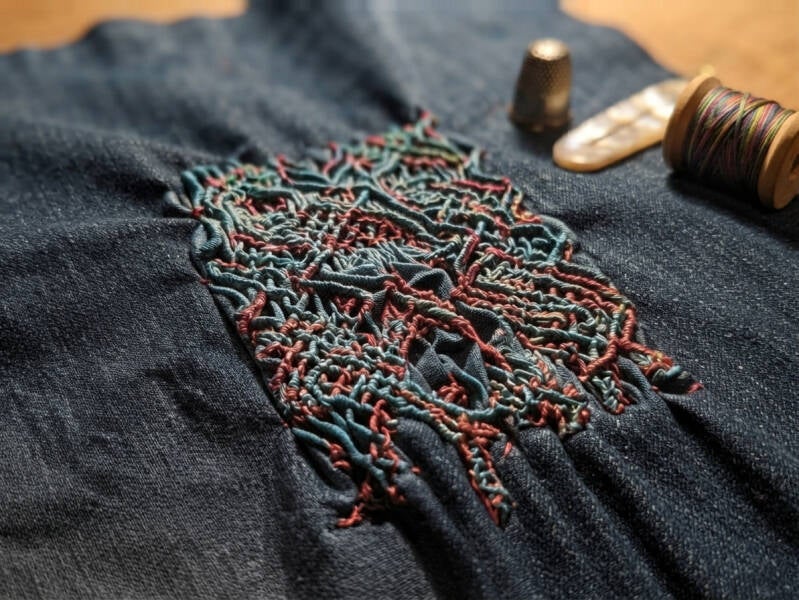
(AI example Advanced Smocking Art)
Modern interiors can use traditional needlework
I think we sometimes make the mistake of believing that traditional crafts belong only in traditional interiors.
They don't.
A beautifully made piece of needle art can work wonderfully in a modern home.
Imagine a large neutral linen wall hanging with a very simple smocked pattern.
No bright colours.
No unnecessary decoration.
Just beautiful fabric, careful stitching and texture.
It could work in a contemporary living room just as easily as in a country house.
The secret is not necessarily the technique.
It is how you use it.
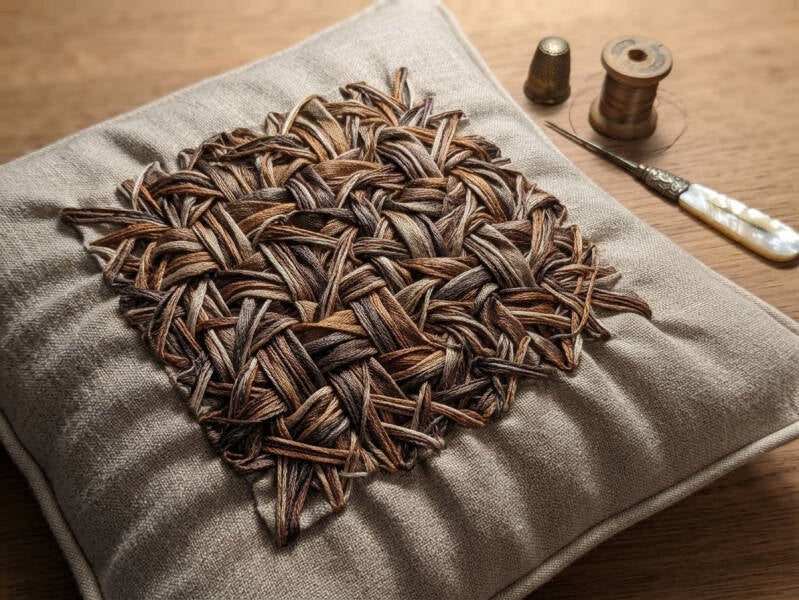
(AI example Advanced Smocking Art)
And yes… we are going to make some
All this has made us rather enthusiastic about experimenting with smocking as textile art.
We are currently working towards creating new handmade wall hangings in which smocking will be an important part of the design.
So, yes, you could call it:
Real Smocking Art.
Not a little detail hidden on a blouse, but smocking as the artwork itself.
We are still developing the designs, so I am not going to reveal everything yet. I am very curious to see how this old needlework technique will look when it is taken out of the sewing room and brought onto the wall.
Should you have a particular idea in mind, we can also create smocked textile art by commission.
A wall hanging, a decorative cushion, or another interior textile can be designed specifically for your home, using natural fabrics and traditional needlework techniques.
Perhaps that is the nicest thing about traditional crafts.
They do not have to remain in the past.
We can take an old technique, give it a new purpose, and let it become something completely different.
The old books on my shelf may still look wonderfully old-fashioned. But its needlework techniques?
These are timeless.
Marga van der Vet
~Textile Artist~
-
 Scandinavian Throw Blanket €165.00
 -
 Country Quilt or Wall Hanging €155.00
 -
 Couture-Style Artisan Cushion €245.00
 -
 Handcrafted Cranes Wedding Gift €165.00
 -
 Minimalist Cotton Linen Throw €148.00


Add comment
Comments